Making its world premiere at the Seoul Motor Show, the Kia Naimo electric concept car combines Korean heritage with innovative modern features.
Taking its name from the Korean word “Ne-mo”, (pronounced ‘Neh-mo’, meaning ‘square shape’), the KIA Naimo electric crossover utility vehicle (CUV) was conceived by Kia’s international design team in Seoul, and is characterized principally by its simple lines and solid, muscular stance.
The uncomplicated overall design is accentuated by a number of striking key details, such as the wraparound windscreen and asymmetric sunroof design, and the front and rear dot-style LED head- and positioning-lamps. Asian Celadon-style pottery, in particular, was a major influence on the car’s styling – with the pottery’s asymmetric form lending itself to the sunroof design, and the typical jade coloring giving Naimo its unique exterior finish.
Kia’s design team also made use of innovative technology features to give the KIA Naimo a premium feel and to ensure the car’s exterior remained uncluttered. For example, KIA Naimo has no traditional wiper blade on the windscreen – instead it employs a high-intensity air jet at the base of the windscreen that performs an ‘air wiper’ function. Conventional door mirrors have also been replaced with miniature cameras installed in the A-pillars.
KIA Naimo’s interior was designed to evoke a strong sense of tranquility and features hand-crafted materials throughout. Korean oak is used to trim the interior door panels and the entire interior floor, Korean “Han-ji” paper is used for the head lining. Alongside these traditional elements sit modern features such as a TOLED (transparent organic light emitting diode) storming display instrument panel and full device connectivity.
Measuring 3,890 mm in length, the KIA Naimo’s generous wheelbase, width and height (2,647, 1,844 and 1,589 mm respectively) – plus the short overhangs which place a wheel at each corner – ensure that the cabin provides exceptional head, leg and shoulder room for the occupants.
The KIA Naimo concept car has no B-pillars and features rear-hinged rear doors to maximize easy access to the cabin, and a three-way split opening trunk, allows versatile access to the load bay for varying luggage sizes.
Power comes from a PMSM (Permanent Magnet Synchronous Motor) electric motor with a maximum output of 80 kW (109 ps) and maximum torque of 280 Nm, enabling KIA Naimo to reach a top speed of 150 kph (93 mph).
A twin-pack 27 kWh battery is located under the trunk floor and uses innovative LiPoly (Lithium Ion Polymer) technology that offers numerous advantages over other battery types. Equipped with this battery, the KIA Naimo provides a driving range of 200 km (124 miles) on a single charge. To enhance range, the showcar is fitted with special low-drag 20-inch diameter alloy wheels.
Under the quick recharging cycle (50 kW) the KIA Naimo’s battery can be recharged to 80 percent of its capacity within 25 minutes. Under the normal cycle (3.3 kW), 100 percent power is attained after five and a half hours.
Showing posts with label rally. Show all posts
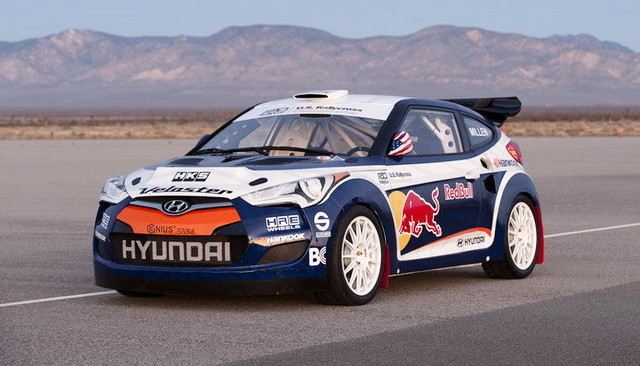
Hyundai Veloster Rally Car
With the next generation of Hyundai buyers eagerly awaiting the upcoming launch of the 2012 Veloster, Hyundai fuels the excitement by teaming with Rhys Millen Racing (RMR) and Red Bull to campaign the car in the high-energy sport of rallycross.
At the 2011 Chicago Auto Show, Hyundai Motor America adds the Veloster coupe to its motorsports program with the help of champion race car driver Rhys Millen, who fabricated and will race the first 500-horsepower AWD Hyundai Veloster rally car in the 2011 U.S. Rallycross Championship. RMR and Hyundai are constructing a second Veloster rally car that will be a shared ride between rally champion Marcus Dodd and world record freestyle motorbike rider Robbie Maddison. Millen and Maddison will drive the Hyundai Veloster rally cars at Summer X Games. A third Veloster rally car will be constructed to compete in the 2WD class in limited number of U.S. Rallycross Championship events and will be piloted by to-be-announced celebrity drivers.
"We feel the Veloster is a perfect fit for X Games and the U.S. Rallycross Championship series as we expand our motorsports efforts," said Mike O'Brien, vice president, Product and Corporate Planning, Hyundai Motor America. "The all-new 2012 Veloster is a playful, fun to drive car and thanks to Rhys and his team we're excited to introduce it to racing fans ahead of its launch this summer. I teamed up with Rhys' father, Rod, nearly twenty years ago for Hyundai's original Pikes Peak rally program, so it is great to be back in the sport again with his son inspiring a new generation."
"The Veloster Concept inspired me to expand Hyundai's motorsports program back into their routes of rally," said Millen, professional race driver and founder of RMR. "We've transformed the Veloster's lightweight, rigid architecture into a rally car with an engine producing 500-horsepower and 600 lb.-ft. of torque. We hope some of the performance learning's from the Veloster rallycross program have a role in the development of future Veloster models."
THE CHASSIS BUILD
Twelve RMR employees applied everything they know about fabricating racecars into the Hyundai Veloster rally Car. The production Veloster was stripped to bare metal and the chassis spent five days in an Alkali bath removing all rubber and adhesives. The chassis was also stitch welded for added structural rigidity.
CARBON/KEVLAR BODY PANELS
Millen quickly decided to take the already light weight Veloster and make it even lighter. His crew took molds of the Veloster body panels to replicate them out of carbon/Kevlar. The hood, doors, quarter panels, front fascia and rear fascia are all built out of carbon/Kevlar. The carbon/Kevlar panels are 75 percent lighter than the sheet metal they replaced. This weight-saving approach is carried throughout the car without compromising its powerful curves and surface detail or hidden third door.
Downforce has been further increased by a custom RMR rear wing. The hood is vented to dissipate heat. The curb weight for the car is 2,656 pounds.
INTERIOR
The interior of the RMR Red Bull Hyundai Veloster rally car is unrecognizable from its origins as a well-appointed sporty coupe designed with everyday driving in mind. All comfort and convenience features are removed to make way for a custom-fabricated eight-point safety cage and firewall which reinforce the Veloster's already stiff chassis. Braces on the A and B pillars also tie into the strength of the body. The safety cage is required for rallying and a Sparco racing seat further protects the driver in the overhauled cockpit.
SUSPENSION
The RMR Red Bull Hyundai Veloster rally car utilizes a custom suspension with a lot of travel for the jumps rallycross cars have to make.
WHEELS, TIRES AND BRAKES
To ensure that the enhanced power plant translates all the way to track performance, RMR added custom built 18-inch HRE wheels and 245/40-18 Hankook Racing tires. Stopping power comes from 14-inch Alcon brake rotors and six piston Alcon calipers. The entire carbon/Kevlar body is wrapped in a paint scheme combination of blue, white and orange.
RALLYCROSS
A race consists of five rally-style cars jumping and sliding on a road course made of pavement and gravel. Five drivers line up to start at once, piloting 500+ horsepower four wheel drive compact cars through race traffic over a challenging short course that features jumps, unbanked turns, dirt and pavement. Each car must also take a "Joker" lap at some point during their heat. A Joker lap is a small detour - normally over a jump - that adds a level of unpredictability to the heat's outcome, by changing a driver's strategy in an instant.
HYUNDAI VELOSTER RALLY CAR
At the 2011 Chicago Auto Show, Hyundai Motor America adds the Veloster coupe to its motorsports program with the help of champion race car driver Rhys Millen, who fabricated and will race the first 500-horsepower AWD Hyundai Veloster rally car in the 2011 U.S. Rallycross Championship. RMR and Hyundai are constructing a second Veloster rally car that will be a shared ride between rally champion Marcus Dodd and world record freestyle motorbike rider Robbie Maddison. Millen and Maddison will drive the Hyundai Veloster rally cars at Summer X Games. A third Veloster rally car will be constructed to compete in the 2WD class in limited number of U.S. Rallycross Championship events and will be piloted by to-be-announced celebrity drivers.
"We feel the Veloster is a perfect fit for X Games and the U.S. Rallycross Championship series as we expand our motorsports efforts," said Mike O'Brien, vice president, Product and Corporate Planning, Hyundai Motor America. "The all-new 2012 Veloster is a playful, fun to drive car and thanks to Rhys and his team we're excited to introduce it to racing fans ahead of its launch this summer. I teamed up with Rhys' father, Rod, nearly twenty years ago for Hyundai's original Pikes Peak rally program, so it is great to be back in the sport again with his son inspiring a new generation."
"The Veloster Concept inspired me to expand Hyundai's motorsports program back into their routes of rally," said Millen, professional race driver and founder of RMR. "We've transformed the Veloster's lightweight, rigid architecture into a rally car with an engine producing 500-horsepower and 600 lb.-ft. of torque. We hope some of the performance learning's from the Veloster rallycross program have a role in the development of future Veloster models."
THE CHASSIS BUILD
Twelve RMR employees applied everything they know about fabricating racecars into the Hyundai Veloster rally Car. The production Veloster was stripped to bare metal and the chassis spent five days in an Alkali bath removing all rubber and adhesives. The chassis was also stitch welded for added structural rigidity.
CARBON/KEVLAR BODY PANELS
Millen quickly decided to take the already light weight Veloster and make it even lighter. His crew took molds of the Veloster body panels to replicate them out of carbon/Kevlar. The hood, doors, quarter panels, front fascia and rear fascia are all built out of carbon/Kevlar. The carbon/Kevlar panels are 75 percent lighter than the sheet metal they replaced. This weight-saving approach is carried throughout the car without compromising its powerful curves and surface detail or hidden third door.
Downforce has been further increased by a custom RMR rear wing. The hood is vented to dissipate heat. The curb weight for the car is 2,656 pounds.
INTERIOR
The interior of the RMR Red Bull Hyundai Veloster rally car is unrecognizable from its origins as a well-appointed sporty coupe designed with everyday driving in mind. All comfort and convenience features are removed to make way for a custom-fabricated eight-point safety cage and firewall which reinforce the Veloster's already stiff chassis. Braces on the A and B pillars also tie into the strength of the body. The safety cage is required for rallying and a Sparco racing seat further protects the driver in the overhauled cockpit.
SUSPENSION
The RMR Red Bull Hyundai Veloster rally car utilizes a custom suspension with a lot of travel for the jumps rallycross cars have to make.
WHEELS, TIRES AND BRAKES
To ensure that the enhanced power plant translates all the way to track performance, RMR added custom built 18-inch HRE wheels and 245/40-18 Hankook Racing tires. Stopping power comes from 14-inch Alcon brake rotors and six piston Alcon calipers. The entire carbon/Kevlar body is wrapped in a paint scheme combination of blue, white and orange.
RALLYCROSS
A race consists of five rally-style cars jumping and sliding on a road course made of pavement and gravel. Five drivers line up to start at once, piloting 500+ horsepower four wheel drive compact cars through race traffic over a challenging short course that features jumps, unbanked turns, dirt and pavement. Each car must also take a "Joker" lap at some point during their heat. A Joker lap is a small detour - normally over a jump - that adds a level of unpredictability to the heat's outcome, by changing a driver's strategy in an instant.
HYUNDAI VELOSTER RALLY CAR
- Curb weight: 2,656 pounds
- Engine: Hyundai 500-horspower four-cylinder turbocharged
- Transmission: Xtrac six-speed sequential
- Transfer case: Xtrac four wheel drive
- Front and rear differentials: Xtrac
- Suspension: Proflex jumbo coil over
- Front Brakes: 14-inch Alcon rotors with 6-piston Alcon calipers
- Rear Brakes: 12-inch Alcon rotors with 6-piston Alcon calipers
- Wheels: 18 x 8.5-inch HRE
- Tires: 245/40-18 Hankook racing tire
- Seats and harnesses: Sparco